
The Tiwaz, a new open-source split keyboard designed by Timo Strube, is preparing for a production run on the hardware crowdfunding platform Crowd Supply. While many split keyboards focus primarily on office ergonomics, the Tiwaz is designed as a hybrid device where each half can function as a fully independent one-handed gaming controller or macro pad.
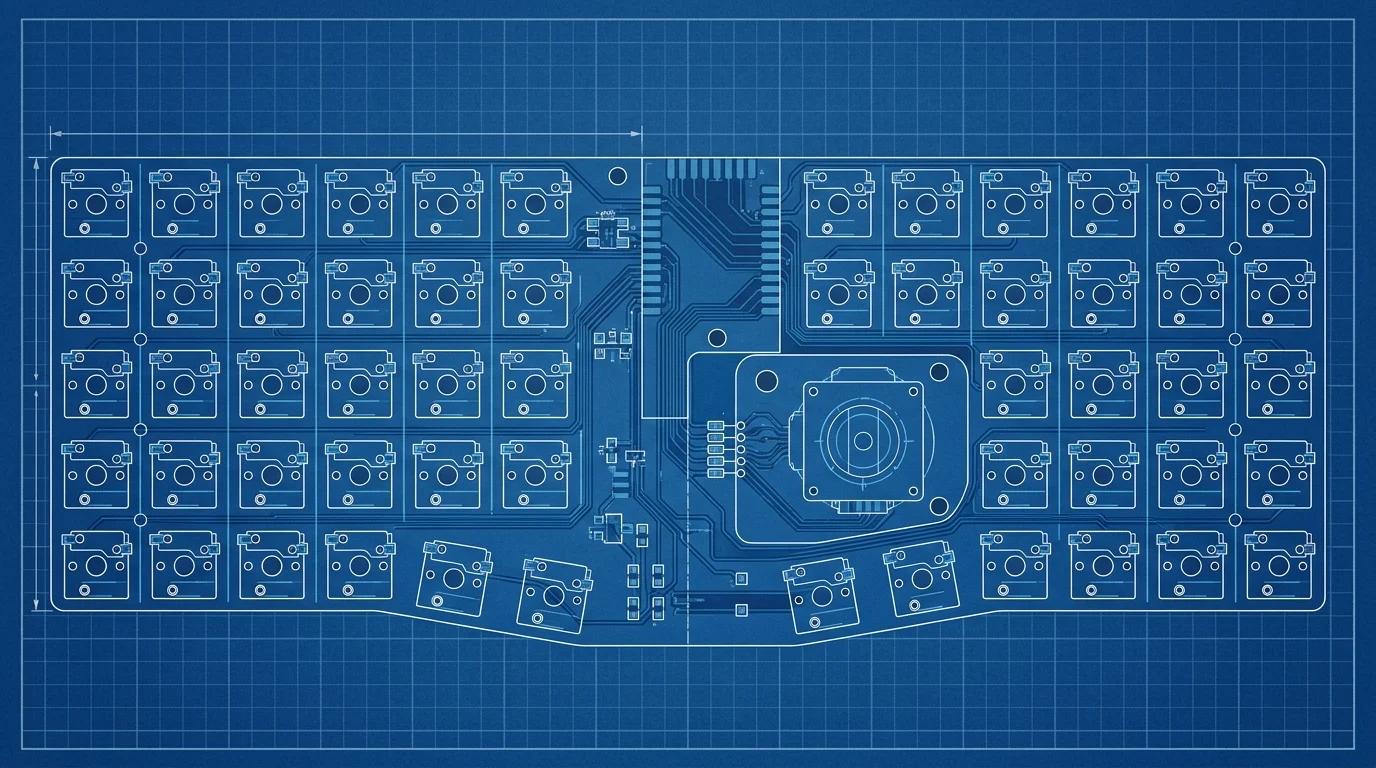
The keyboard features a total of 76 keys—38 per side—arranged in an ortholinear layout. This grid-like configuration represents a technical departure from the “columnar stagger” found on many high-end ergonomic boards, such as the ZSA Voyager, which shifts key columns vertically to match varying finger lengths. By choosing a strict ortholinear alignment, the Tiwaz prioritizes a predictable layout for gaming inputs while maintaining the split-hand benefits of an ergonomic device.
Gaming-First Hardware and Modular Joysticks
The defining feature of the Tiwaz is its integrated thumb joysticks, located on the inner edge of each half. These controls are highly configurable through firmware, allowing users to map them as analog gamepad sticks, digital directional pads, or mouse movement inputs.
To accommodate different hardware preferences, the design supports multiple joystick types, including standard Alps Alpine modules or Sony PSP-style sliding joysticks. When used in its “standalone” mode, a single half of the keyboard can be connected via USB-C to serve as a compact gaming keypad, leaving the other half aside to maximize desk space for mouse movement.
Internal Specifications and Precision
Technical refinements in the final design reflect a shift toward input stability. While early prototypes utilized the Raspberry Pi RP2040 microcontroller, the production-ready version of the Tiwaz has transitioned to an STMicroelectronics STM32F401. This change was made specifically to utilize the chip’s 12-bit analog-to-digital converter (ADC), which provides steadier and more precise analog reads for the joysticks compared to the integrated ADCs on many hobbyist-grade microcontrollers.
Additional hardware features include:
- Hot-Swap Sockets: Supports MX-compatible mechanical switches without soldering.
- Gasket Mounting: Uses a gasket-mounted plate system and internal damping to reduce case resonance and improve typing feel.
- Lighting: Per-key RGB lighting for visual customization and layer indication.
- Auxiliary Inputs: Six dedicated buttons (three per side) intended for media keys or complex macros.
The project remains committed to the open-source community, with the hardware files licensed under GPL-3 and the firmware under GPL-2. This allows enthusiast builders to modify the PCB or case designs for personal use. For those looking for a pre-built unit or a verified kit, the Crowd Supply campaign will serve as the primary channel for the initial commercial rollout.
Because each half contains its own MCU and processing logic, the Tiwaz effectively functions as two separate devices that sync when connected together, providing a level of redundancy and flexibility rarely seen in standard split mechanical keyboards.


