
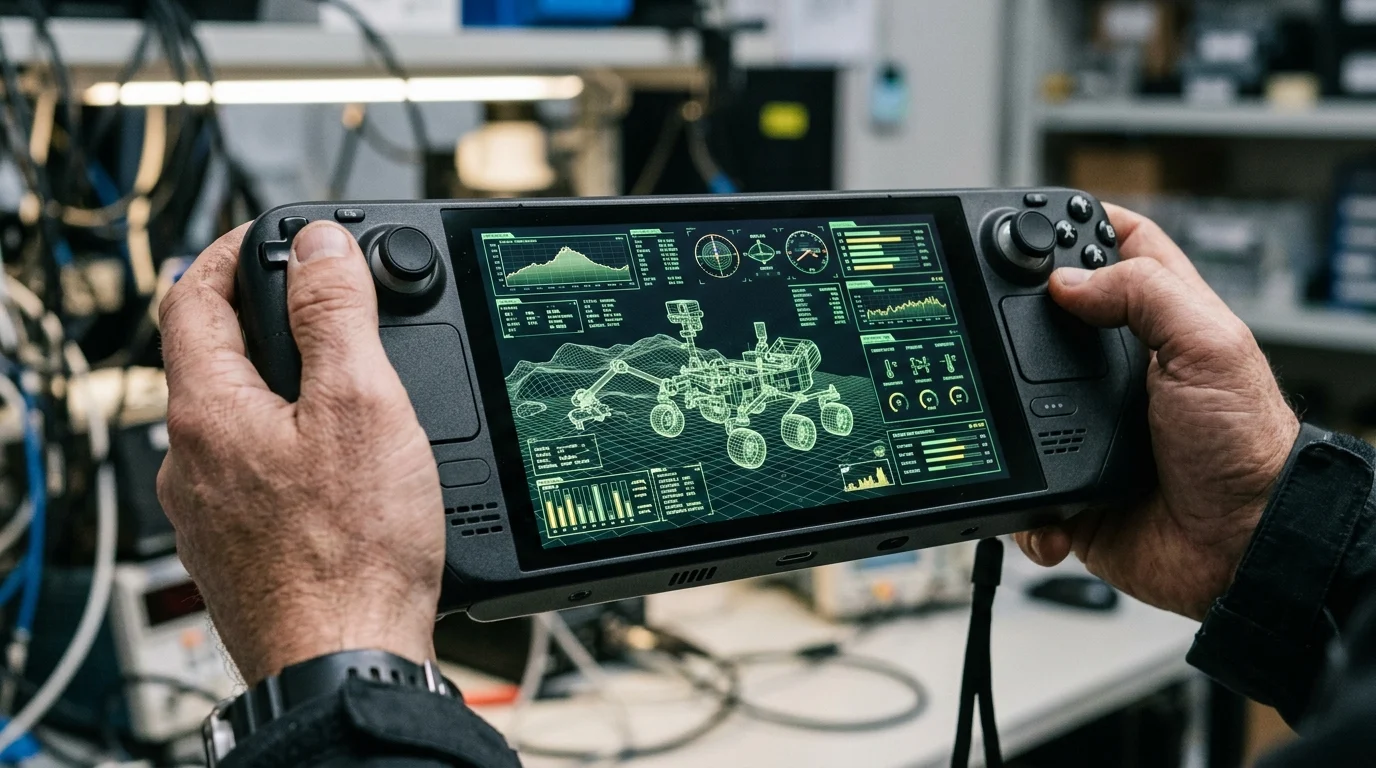
Airbus engineers at the Stevenage facility in the UK have integrated Valve’s Steam Deck into the development cycle of the Rosalind Franklin Mars rover. While the handheld is primarily designed for consumer gaming, its ergonomic layout and open-source foundation have made it an effective steering tool for navigating the multi-million-pound prototype through Earth-bound test beds.
The Rosalind Franklin rover is the centerpiece of the ExoMars mission, a collaborative effort led by the European Space Agency (ESA). Currently scheduled for launch in October 2028 aboard a SpaceX Falcon Heavy, the mission is expected to land at Oxia Planum in November 2030. Once on the Martian surface, the rover will search for signs of past life by drilling up to two meters underground.
The Logic of Gaming Hardware in Aerospace
The decision to use a Steam Deck over specialized industrial equipment or standard laptops stems from the device’s unique combination of hardware and software. Engineers noted that the physical joysticks and triggers provide more intuitive real-time feedback when maneuvering the six-wheeled vehicle through tricky terrain than a keyboard could offer.
Technically, the Steam Deck’s Arch Linux-based architecture allows the engineering team to bypass the “walled garden” restrictions typically found in other handheld consoles. Because the device is essentially a portable PC, the team can execute custom Robot Operating System (ROS) nodes and web APIs directly on a stock unit. This openness enables the hardware to communicate with the rover’s complex systems without the need for proprietary peripheral drivers or heavy physical modifications.
Ground Testing vs. Martian Reality
While the Steam Deck serves as an essential interface in the Stevenage “Mars Yard,” it will not be used to drive the rover on the actual Martian surface. Due to the vast distance between Earth and Mars, signal delays can range from 4 to 24 minutes one-way, making manual real-time steering impossible. Instead, the flight model of the Rosalind Franklin rover is designed for high-level autonomy, using onboard cameras and sensors to map its own path across the terrain.
This use of consumer tech for high-stakes prototyping follows a growing trend in robotics. Disney previously utilized Steam Decks to control its free-roaming BDX droids at theme park attractions, signaling a shift toward repurposing refined consumer ergonomics for specialized tasks. For Airbus, which is tasked with designing the mechanical, thermal, and propulsion systems for the rover’s landing platform, the gaming handheld provides a reliable and cost-effective solution for ground-side verification and testing phases.


